
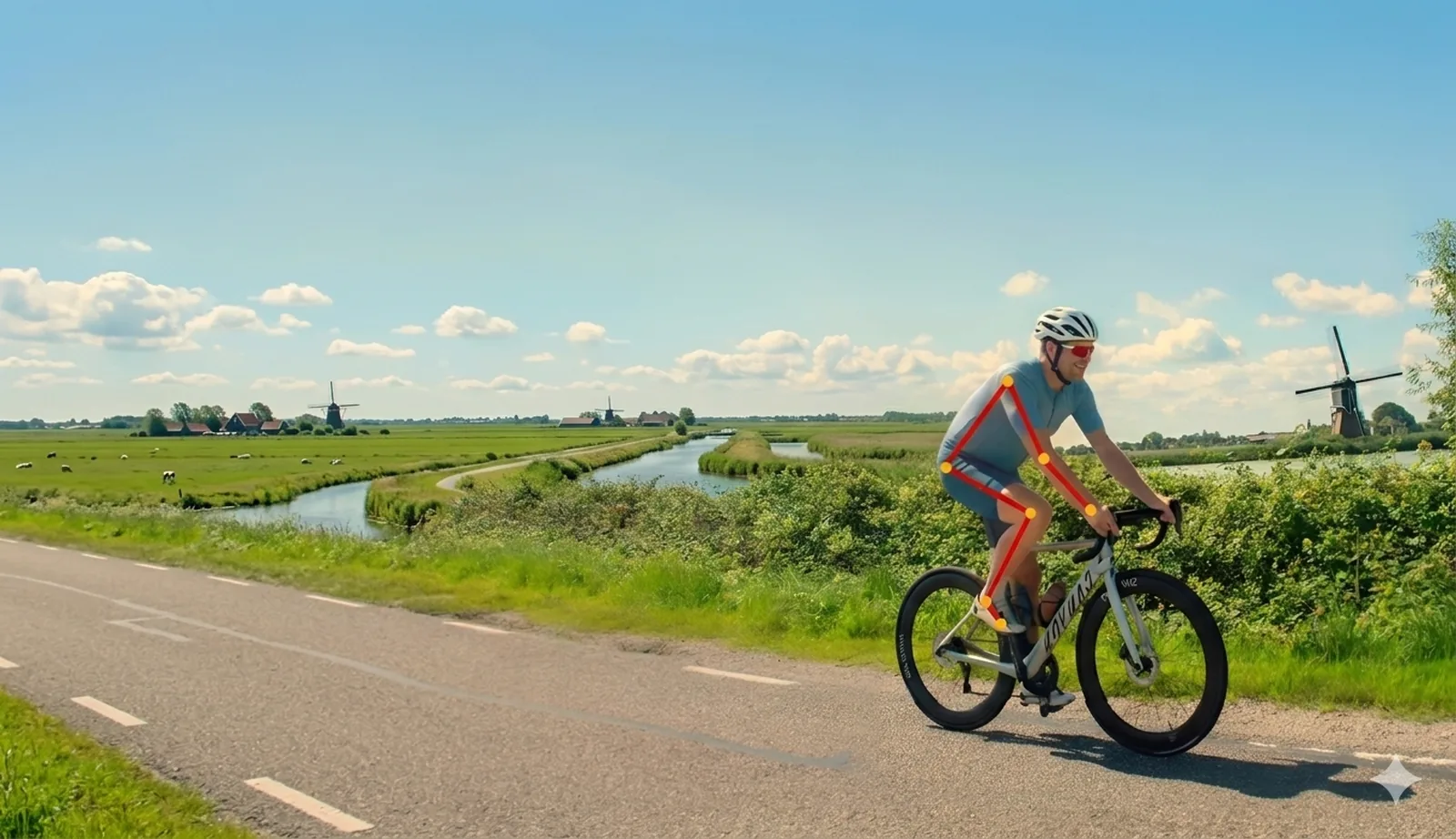
What is the ideal road bike position?
Road bike position: A personal and complex trade-off between power, comfort, aerodynamics and control.

This guide on road bike position explains everything you need to know. The right bike position and fit are more important than you think, and most people don't know enough about them. Not every road bike suits every rider or every goal. That's why it pays to look into this before you buy a bike, not after.
Your bike fit (and therefore your position) has a major impact on these five factors:
- Peak power • hitting your maximum power and speed
- Efficiency • optimising for long rides; less wasted energy
- Comfort • fewer aches in your neck, back, shoulders, etc.
- Aerodynamics • minimising air resistance
- Bike handling • good control over the bike
Unfortunately, there is no single fit that maxes out all five factors at once. You'll have to find a compromise that fits your cycling goals. If you want to go all-in for an hour, peak power matters more than efficiency. If you ride long recreational rides, comfort and efficiency carry more weight.
Your personal characteristics matter too. Younger riders are often less sensitive to comfort and injuries than older riders, for example.
In short: dialling in your ideal road bike position is a personal and complex trade-off.
To help you with this we've built an online bike fit tool. The tool asks you a series of questions about your goals and body characteristics, and based on that calculates the position and fit that's optimal for you.
How do you find your best road bike position?
Your cycling position is determined by the three contact points between you and the bike: the pedals, the saddle and the handlebars. In this article we focus on the two most important ones: saddle and handlebar position. Fully optimising your position involves many more adjustments.
Saddle height and saddle position
There are many ways to determine your optimal saddle height, from simple (less reliable) rules of thumb to a video analysis of your pedal stroke. A common rule of thumb is: saddle height = 0.88 × your inseam length. For an average person this works fine, but most people aren't average.
If you're very tall or short, have a non-average shoe size, are very flexible or not flexible at all, or have a non-standard riding style, then rules of thumb often won't work well.
Saddle position determines the effectiveness and efficiency of your pedal stroke. That's why a lot of scientific research has gone into optimal saddle height. The research shows, for example, that the optimal saddle height for peak power is slightly higher than the optimal saddle height for maximum efficiency.
Setback and saddle angle
Beyond saddle height, it's also important to dial in the horizontal saddle position (saddle setback) and the saddle angle (tilt). If these are wrong they can cause various complaints and injuries.
Our online bike fitting tool has a very complete saddle position calculation. We take into account your cycling goals, several body measurements, your fitness and flexibility and your crank length. That gives a much better result than rules of thumb. It remains a calculation, however, and not all exceptions can be accounted for.
If you have a significant leg-length difference, for example, or an unusual riding style, then we recommend a fit with an in-person expert.
Handlebar position on your road bike
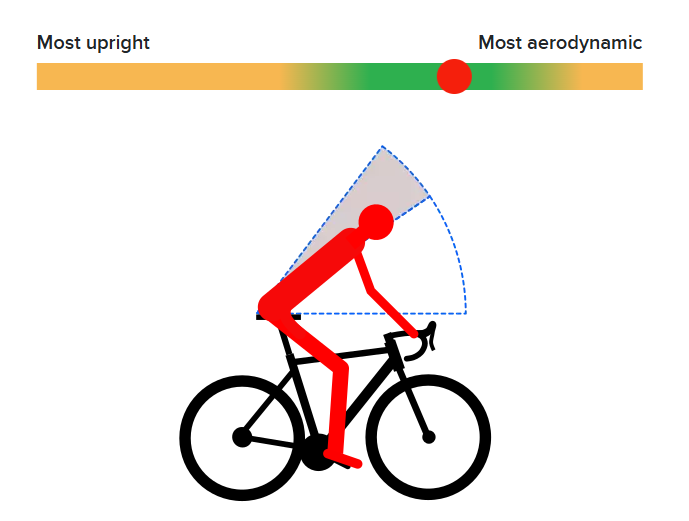
Your handlebar position relative to the saddle determines how stretched out and aerodynamic your riding position is. There's a trade-off between aerodynamics (catching little wind) and comfort. So for the same person multiple handlebar positions are possible.
For an all-out hour of riding, aerodynamics matters and you can pick a deeper position (smaller back angle). For a 5-hour recreational ride in the mountains, more comfort is preferable, so a more upright position (larger back angle).
A deep aerodynamic position isn't sensible for everyone. What you can handle depends on how trained and flexible you are and on your sensitivity to back and neck issues.
Reach and drop
Handlebar position is described by reach (horizontal distance from saddle to bars) and drop (vertical height difference). The combination of reach and drop should fit your torso and arm length.
For a deeper position (smaller back angle) you need not only more drop but also more reach. If the combination is wrong it can cause back, neck and shoulder complaints.
Tailored advice
In our bike fitting advice we first ask a few questions about your fitness and goals. Based on that we recommend a back angle, which you can adjust if you want. Then we ask for body measurements like torso and arm length. Based on all that information we calculate your optimal handlebar position.
How do you adjust the position on your road bike?
Once you know which saddle and handlebar position you need, you can start adjusting your road bike to your numbers. Doing this in the correct order matters. And give your body time to get used to the new position.
A better position can feel unfamiliar at first because your body may have been used to a different one for years. Read more in our article on How to adjust your road bike.
Ready to optimise your bike fit?
Get a personalised bike fitting report in just 15 minutes.
Start your bike fit