
Knee pain cycling: how to fix knee pain from cycling
Knee pain cycling: If your knees hurt when cycling, the cause depends on where the pain sits: kneecap, outside, inside or back of the knee. This article shows how to fix knee pain from cycling per type.

This guide on knee pain cycling explains everything you need to know. If your knees hurt when cycling, the cause is usually an incorrect bike setup and riding position. Other possible causes might be: an incorrect cycling technique, overtraining, an underlying physical problem, or a combination of several of these factors. If you suspect a physical problem, we advise you to contact a sports physician to have it evaluated.
For the most common types of knee pain cycling, we explain the possible causes and how you can solve them. In most cases a proper bike fit is (part of) the solution. With a bike fit, the position of your contact points with the bike is optimised for your physique, fitness and cycling goals. With your feet, buttocks and hands in the right position, you will experience less pain and your cycling performance probably improves as well.
On our website we offer a low-priced online bike fit. A bike fit can also be done at a specialist, but this will be about 10 times as expensive and cost you much more time. Our online bike fit has already helped many people to get rid of their cycling knee pain.
Cycling knee pain explained: most common causes
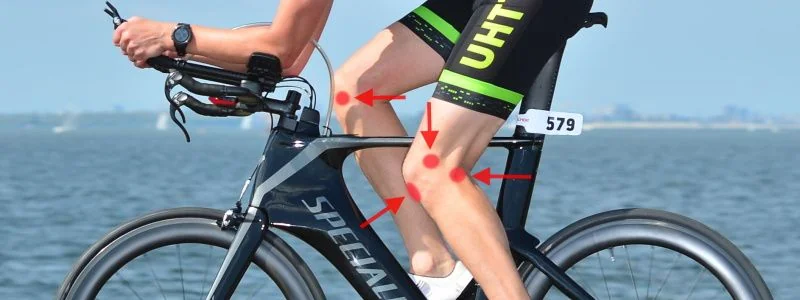
As indicated earlier, knee pain cycling can be caused by your bike setup, incorrect technique, overtraining, and/or underlying physical problems. Each cause is clarified in the following paragraphs.
Wrong bike setup
If your bike is not set up properly, certain body parts will experience a heavier load than required. This might lead to irritation, pain and injuries, especially during long or intense bike rides.
General advice for knee pain: check your cleats and/or pedals for wear and tear. If the cleats or pedals wear out, the connection between the shoes and the pedal becomes less stable and might also be slightly skewed. This might result in knee problems.
Other bike setup issues that can cause knee problems are:
- Incorrectly positioned cleats
- Saddle too high or too low
- Saddle too far forward or backward
- Crank arm too long
Wrong cycling technique
Incorrect pedalling technique can also be the cause of knee injuries. This is often caused by an incorrect setup of the bike. If your bike is not properly set up, your body has to adapt to this, causing an incorrect pedalling movement. Always change your bike setup in small portions and let your body get used to it for a few rides before making the next adjustment.
With the optimal pedalling technique, your knee goes up and down in quite a straight line and you preferably cycle with a high cadence of 90rpm or more. At a lower rpm, the forces on your knees are much greater, and therefore the risk of an overload increases.
Overtraining
The chance of knee problems increases considerably when you suddenly increase your cycling load. Especially if you go cycling in the mountains while not well trained for it: uphill you might be forced to cycle with a low cadence and high power, which increases the forces on your joints, tendons and muscles enormously.
Physical problems
A physical problem that has been present for some time, or arose during other activities, might now be causing complaints while cycling. For example, when you experience pain at the outside of your knee (runner's knee) as a result of running, there is a risk that this will give you discomfort while cycling. In this situation, address the source of the problem and adjust the cycling load if necessary for the recovery process.
If cycling is the root cause of the knee pain, then an incorrect bike setup is often (part of) the problem. When the bike setup and riding position are corrected, the pain does not always disappear immediately. The injured tissue often needs some time to recover first.
Pain on the outside of the knee while cycling
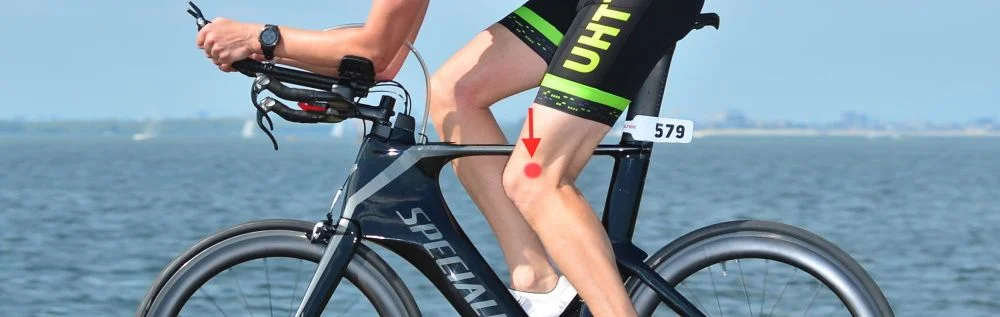
Pain on the outside of the knee while cycling is often related to an incorrect position of your feet on the pedals. Adjust the rotation of your cleats so your heels point more inwards.
There is no general guideline for the optimal foot position. For one individual the heels should be inwards, for others a neutral position might suit best. In the appendix to our bike fit report we explain how to determine your optimal foot position.
Pain on the inside of the knee while cycling
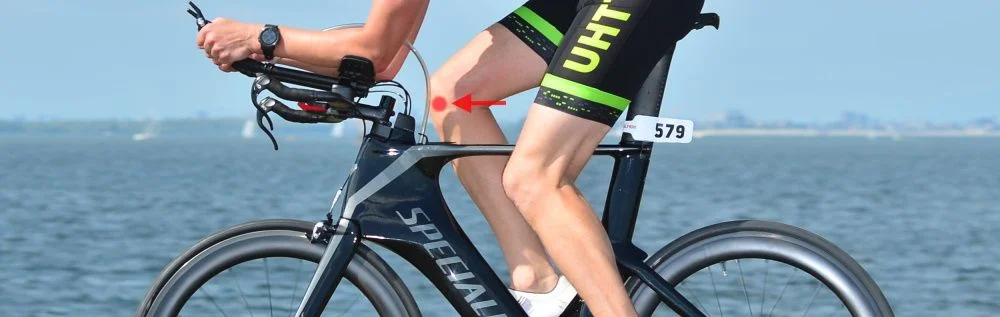
If you have pain on the inside of the knee, test whether an opposite cleat adjustment helps. Adjust the rotation so the heel of your foot is slightly more outwards.
Only change the rotation a little at a time and test the new position on shorter, less intense rides. If this goes well, you can consider a further adjustment.
Pain under the knee cap cycling: front of the knee
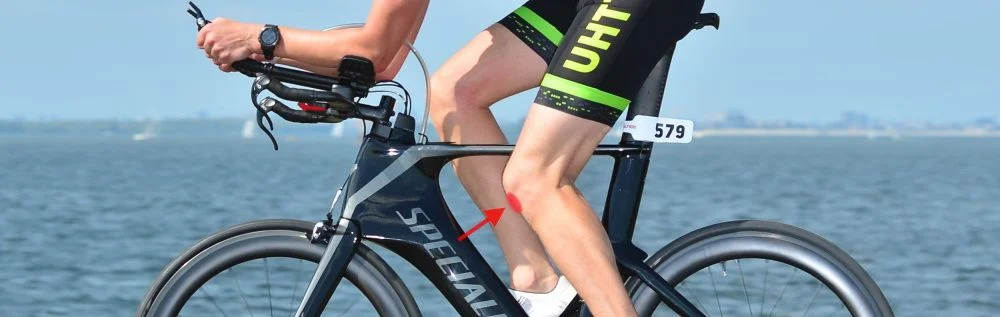
Pain under the knee cap and at the front of the knee is usually caused by your knee making too sharp an angle in the top pedal position, increasing the forces around the kneecap. In most cases this is because your saddle is too low, a common reason your kneecap is sore after cycling. With our Online Bike Fitting you can easily determine your optimal saddle height.
On the internet you can also find various free rules of thumb for calculating saddle height. These often provide a good indication, but are less accurate by not taking all relevant factors into account.
The wrong horizontal saddle position can also cause knee pain. If your saddle is too far forward, it might result in pain at the front of the knees. If your saddle is in the correct position and the pain persists, you might consider having a shorter crank fitted to your bicycle.
Pain on the back of the knee / in the popliteal
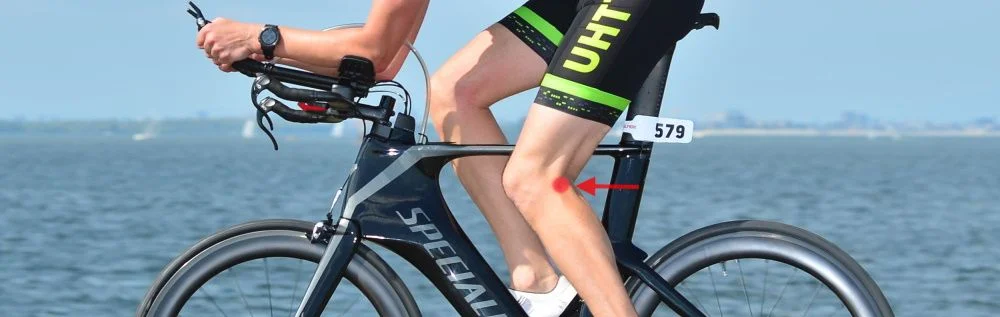
Back-side knee pain is usually the result of hyperextension of the knee. Your saddle is probably too high and/or too far back. You can use our Online Bike Fitting to calculate your optimal saddle position.
Knee pain cycling recovery: during or after the ride
Different types of knee pain after cycling have a different pain course. Some hurt at the beginning but resolve after a bit of cycling. Others worsen progressively, or you only feel pain after cycling. The course of the pain is often a good indication of the cause and the knee pain cycling recovery you need.
Tendon issues that are still low-grade often cause pain only after the activity. More serious tendon issues are present throughout the whole ride. If you have pain all day, including at rest, then you have the most serious degree of a tendon injury, for example the patellar tendon at the front or the hamstring tendon attachment in the popliteal space.
Kneecap irritation (patellofemoral pain syndrome) is felt at the front, especially when more force has to be applied, uphill or in strong headwind. The so-called runner's knee (irritation of the iliotibial tract at the knee) typically starts to hurt after a number of kilometres and worsens during the rest of the ride. A cartilage problem is less likely to cause complaints during or after cycling but might cause swelling.
We're happy to help you get rid of your knee problems. The first step is a good bike fit to ensure an optimal riding position. In case of serious pain, we also advise visiting a general practitioner or sports physician for a physical evaluation.
Want to know exactly which measurements suit your body? Take our online bike fit and get your personal report right away.
About the author
Karin is a sports physician at Meander Medical Center in Amersfoort and, since December 2025, Chief Team Doctor of the FDJ-SUEZ Women's WorldTeam. Before that she was team doctor at Liv Alula Jayco and worked for over 15 years as a sports physician, specialising in exercise testing, injury prevention and bikefitting for cyclists and triathletes. She is a training supervisor in sports medicine and conducted research on health in youth sports (HAYS study, Utrecht University of Applied Sciences).
Related articles
Back pain cycling: causes & fix by type
Back pain cycling — Lower, mid or upper back pain after cycling? Learn why your road bike hurts your back and which bike setup adjustments fix cycling related back pain.
Road bike saddle setup: saddle height and setback guide
Road bike saddle setup, step by step: correct saddle height, saddle tilt and setback for your body. Prevent pains and ride faster with the right setup.
Ready to optimise your bike fit?
Get a personalised bike fitting report in just 15 minutes.
Start your bike fit