
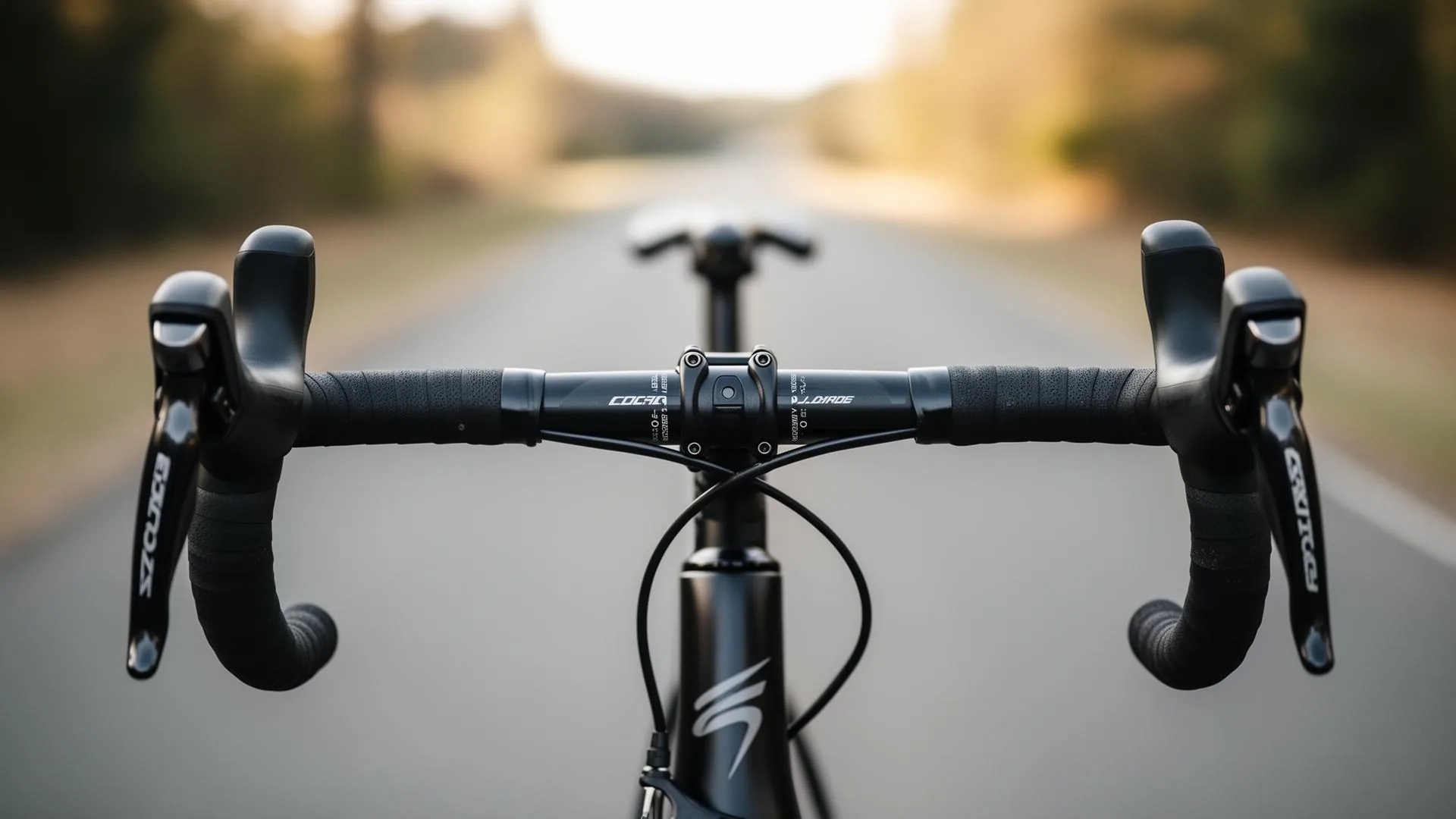
How to determine your optimal handlebar width?
Easy instruction to determine the best Handlebar width for your road bike, gravel bike or mountain bike.

Your bike's handlebar width affects comfort, aerodynamics, and control. A narrower handlebar is more aerodynamic and a wider handlebar gives more control because of the larger lever. The balancing of these conflicting interests is different for the various bicycle types.
The handlebar width is only a small part of your cycling position. You can also do a full online bike fit with us so that you can cycle more comfortably, longer and faster.
How wide should a road bike handlebar be?
For road bikes, the optimum handlebar width is set on maximizing comfort. On a road bike, you typically make longer rides in a static position. Therefore, an uncomfortable position of the arms can easily lead to irritations and pains. A road bike steers lightly, so there is no need for a wider handlebar to increase control. And a narrower handlebar does not provide enough aerodynamic advantage to offset the loss of comfort.
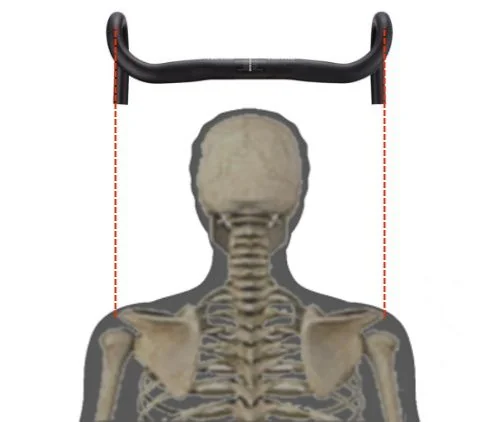
For maximum comfort, the position of your arms needs to be as relaxed as possible. This means that your arms need to be straight forward. For this position, the handlebars should have the same width as your shoulders.
You measure your shoulder width as the widest point of your shoulders that consists of bone. The width of the handlebars is measured center-center. Please note: some manufacturers measure to the outside of the handlebars, resulting in a 23.8 mm larger size.
How wide should a gravel bike handlebar be?
A gravel bike is similar to a road bike, but with a gravel bike you probably will also explore rougher terrains. For rougher terrain, you need more control and therefore a wider handlebar. That is why the handlebar of a gravel bike often has a flare (gets wider towards the end of the bar).
The optimum handlebar width for riding with your hands on top of the brake levers is therefore determined in the same way as for a road bike. Depending on the additional control that you want, you can select a handlebar with less or more flare.

How wide should a mountain bike handlebar be?
With a mountain bike, the optimal handlebar width is mainly determined by the width that you need for sufficient control. And this depends on your riding style and the environment in which you like to cycle. If you cycle in rough terrain or if you sometimes find it difficult to control your handlebar, a wide handlebar is recommended. If you cycle a lot on simple paths, a narrower handlebar offers sufficient control, more comfort and better aerodynamics.
Smaller wheels (e.g. 26 inch) steer lighter compared to large wheels (29 inch). That is why today's mountain bikes have wider handlebars than in the past. Please also be aware that a handlebar that is too wide can cause shoulder and upper back pains.
Unfortunately, there is no general guideline for the optimal handlebar width for a mountain bike. Combine your cycling experiences with the above knowledge to estimate your optimal width.
The advantage of a mountain bike handlebar is that you can easily shorten it yourself. Typically the default handlebar on mountain bikes is wide because manufacturers know it's easy to shorten and impossible to make any longer. If you would like a narrower handlebar, you can shorten it at both ends. To do this, you must first remove the grips and move the brake and shift levers inwards.
Measuring handlebar width and shoulder width
If you want to determine the right handlebar width or check what's currently on your bike, there are two things you want to measure properly: the width of the handlebar itself and your shoulder width as a reference.
Measuring handlebar width (center-to-center)
Handlebar width is measured from the center of one end to the center of the other end, the so-called center-to-center measurement. On a road bike, you measure the distance between the two lower sections of the drops. On an MTB handlebar, you measure between the ends of the straight bar. Important: some manufacturers list the outside-to-outside measurement, which is roughly 23.8 mm larger. So always check how a manufacturer reports their handlebar width before comparing.
Measuring shoulder width
For a road bike, you determine the optimal handlebar width based on your shoulder width. To measure it, find the widest bony point of your shoulders, that is, from the end of one acromion (the bony bump on top of the shoulder joint) to the end of the other acromion. Stand upright and relaxed, and have someone else take the measurement for the most accurate result. This measurement is your direct guideline for handlebar width (center-to-center) on a road bike.
Help with other bike adjustments
We would like to also help you with the optimization of other elements of your bike setup. The most complex is finding your optimal riding position. This is complex because there is not one standard optimal position. Aerodynamics, maximum power, comfort and bike control all have different requirements for your riding position. Your personal cycling goals and priorities therefore play an important role in determining your optimal riding position.
For more explanation, please read our article What is your ideal riding position on the bike.
When determining the riding position, the positions of all your contact points (pedals, saddle, handlebars) with the bicycle are determined. In addition to the correct position, it is also important to optimise the contact points themselves. The articles behind the links below provide important tips and advice on how to do this. How do you determine your optimal:
Want to know exactly which measurements suit your body? Take our online bike fit and get your personal report right away.
Related articles
What crank length do you need?
Explanation on how to determine the best Crank length for your road bike, gravel bike or mountain bike.
Cleat position road bike: how to set up your cleats
Cleat position road bike — How to nail correct cleat position on a road bike or MTB: step-by-step cleat placement for SPD and Look pedals (length, rotation, width).
Ready to optimise your bike fit?
Get a personalised bike fitting report in just 15 minutes.
Start your bike fit