
Saddle height calculator: find your optimal saddle height
Saddle height calculator: Calculate your saddle height based on inseam, crank length, shoe size and riding goal. Plus why the well-known rules of thumb fall short.

This guide on saddle height calculator explains everything you need to know. Saddle height is the single most important adjustment on your road bike. It affects how much power you can put into the pedals, how comfortable you are in the saddle, and how likely you are to develop overuse injuries. Yet a surprising number of cyclists ride with their saddle too high or too low.
Use our saddle height calculator below to find your starting point. All you need is your inseam measurement, crank length and shoe size. Further down, we explain the science behind the calculation, why the well-known rules of thumb don't work for everyone, and which methods give you a more accurate result.
Saddle height calculator
Enter your details for your starting value.
Allowed: 600–1000 mm.
How to measure your inseam
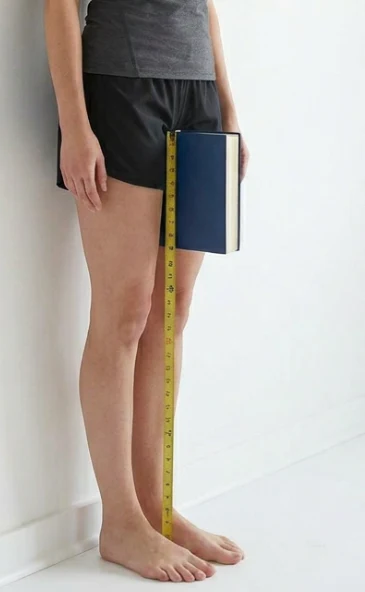
- Grab a thick, sturdy book.
- Stand barefoot with your back against a wall, feet shoulder-width apart.
- Push the book as high as possible between your legs, with one side flat against the wall.
- Measure from the floor to the top of the book. That's your inseam.
Allowed: 34–52 (EU).
Standard sizes from 165 to 180 mm.
Crank length is usually printed on the inside of the crank arm. You can also measure it: from the centre of the bottom bracket to the centre of the pedal axle.
Your saddle height
—mm
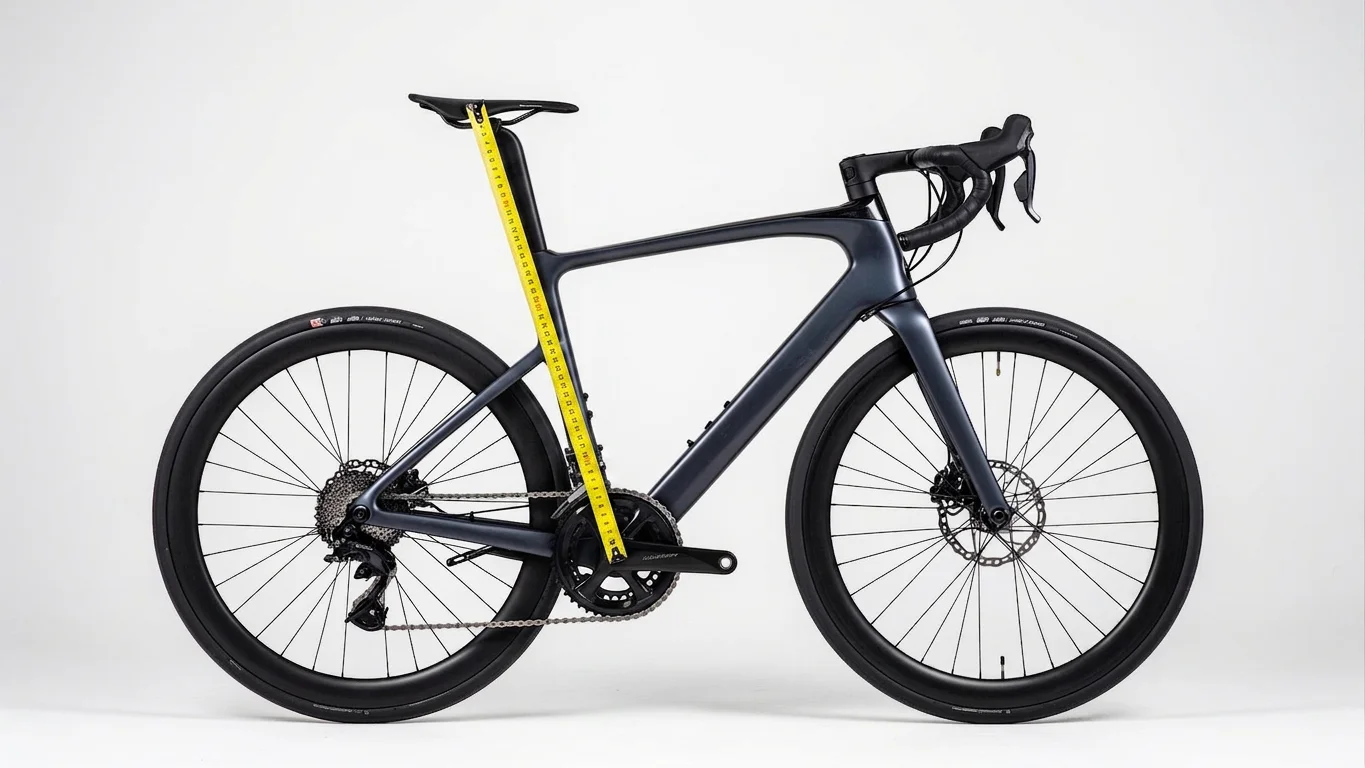
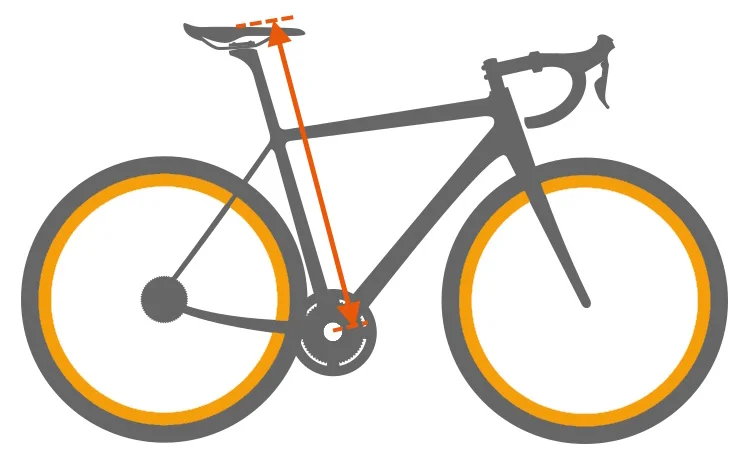
Distance from the centre of the bottom bracket to the top of the saddle, measured along the seat tube.
How to measure on your bike: Saddle height is the distance from the centre of the bottom bracket to the top of your saddle, measured along the line of the seat tube.
This result is a good starting point. Our saddle height calculator is more accurate than the well-known rules of thumb because it also accounts for your crank length, foot size and riding goal. But it's still a simplified calculation. As we show later in this article, the common formulas deviate by 10 to 25 mm from the actual optimal saddle height for most cyclists. Our online bike fit takes more variables into account and also calculates your complete riding position.
The common rules of thumb: and why they fall short
There are three widely used formulas to calculate your saddle height. They're simple and quick, and they get you in the right ballpark. But none of them is truly accurate. A reliable saddle height calculator should account for these factors.
The heel method
The simplest and quickest method. Sit on your bike, place your heel on the pedal at the lowest point (crank in line with the seat tube) and check whether your leg is fully extended without your pelvis tilting. If so, your saddle is approximately right. If not, adjust.
The advantage: you don't need a tape measure or calculator. The disadvantage: it's the least precise method. Research by Peveler et al. (2005) showed that this method only produces a knee angle within the optimal range for 55 to 70% of cyclists.
The Hamley method (inseam × 1.09)
In 1967, Hamley and Thomas investigated at which saddle height cyclists produced maximum power. Their conclusion: the optimal height is 109% of your inseam, measured from the pedal axle to the top of the saddle. Faria and Cavanagh confirmed in 1978 that for every percent deviation from this number, there is approximately a 1% loss in power output.
This is the saddle height formula you'll encounter most often. Here's how it works: measure your inseam (barefoot, with a book pressed firmly into your crotch against a wall) and multiply by 1.09. Note: the result includes crank length. You measure on the bike from pedal axle to saddle, not from bottom bracket to saddle.
The LeMond method (inseam × 0.883)
Developed in the 1980s by Cyrille Guimard, coach of three-time Tour de France winner Greg LeMond. The formula: inseam × 0.883. The difference from Hamley is how you measure: with LeMond, you measure from the centre of the bottom bracket to the top of the saddle, excluding crank length.
For a cyclist of average height with a standard crank length, both formulas produce virtually the same result. But for shorter or taller cyclists, or when using an unusually long or short crank for your height, the two formulas can differ by up to 20 mm. This is because the Hamley formula implicitly includes crank length (you measure from the pedal axle), while LeMond does not.
The problem with all three
These methods all use just one variable: your leg length. That's the fundamental problem when you calculate your saddle height with a rule of thumb. They don't account for your crank length, foot size, flexibility, pedaling style or riding goal. Two cyclists with exactly the same inseam but different shoe sizes, different cranks or very different flexibility get exactly the same number, even though their optimal saddle height differs.
How big is this difference in practice? Ferrer-Roca et al. (2012) studied 23 trained cyclists and found that 56.5% had a saddle height outside the recommended range of 106-109% of inseam. Yet only 26% of them had a knee angle outside the optimal range. In other words: the formula was wrong, but the cyclists had found a reasonable height themselves (through feel and experience). That says something about the limitations of a formula based on leg length alone.
What determines your optimal saddle height, beyond leg length?
Scientific research has revealed an increasing number of factors that influence optimal saddle height. Individually, the effects seem small, but they add up. This is exactly what a good saddle height calculator method considers.
Crank length
What matters most for saddle height is the 6 o'clock position: the moment your leg is fully extended. With a longer crank, the pedal sits lower at that point, so your saddle needs to come down to keep the same leg extension. With a shorter crank it's the opposite: the pedal doesn't drop as far, so your saddle can sit higher relative to the bottom bracket. Crank length therefore directly shifts your optimal saddle height.
The difference between 170 mm and 175 mm cranks is 5 mm on each side of the pedal stroke, enough to noticeably change your knee angle. And the range of crank lengths is growing: where 172.5 mm was the standard for years, there's a clear trend toward shorter cranks. A crank length of 165 mm is now perfectly normal, especially for cyclists with shorter legs or those who prefer a higher cadence. This wider range makes it all the more important to factor crank length into the calculation.
Impact on saddle height: the difference between the shortest (165 mm) and longest (175 mm) common cranks is 10 mm.
Foot length and shoe size
At the bottom of the pedal stroke your foot doesn't sit flat: your heel is angled slightly upward. That means your foot bridges part of the distance between the pedal and the saddle. The larger your shoe size, the bigger that contribution, and the higher your saddle can sit while keeping the same leg extension. With a smaller shoe size it's the opposite: your foot bridges less, so the optimal saddle height drops accordingly. The rules of thumb ignore this entirely.
Impact on saddle height: approximately 10 mm difference between shoe size EU 39 and EU 47.
Pedal and shoe choice
The thickness of your pedal, cleat and shoe sole determines how high your foot sits above the pedal axle. Among modern clipless pedal systems for road bikes (Shimano SPD-SL, Look Kéo, Wahoo Speedplay), the difference is limited: less than 5 mm. If you switch from clipless pedals to flat platform pedals with regular sports shoes, the difference can be larger, up to 10 mm, depending on the thickness of your shoe sole.
Impact on saddle height: less than 5 mm between modern clipless pedal systems.
Flexibility
Tight hamstrings pull the pelvis backward (posterior tilt). This effectively puts you higher on the saddle than someone with supple hamstrings, even though the saddle is at the same height. Holliday and Swart (2021) studied 50 trained cyclists and confirmed that flexibility is a significant predictor of chosen saddle height. Less flexible cyclists benefit from a slightly lower saddle.
Impact on saddle height: 5 to 10 mm difference between very flexible and very stiff cyclists.
Power or efficiency: it depends on what you want
This is a nuance you won't find in any of the rules of thumb. A higher saddle produces more peak power, that's what the Hamley formula (109%) is optimized for. But a slightly lower saddle is more efficient in terms of oxygen consumption, as Nordeen-Snyder showed back in 1977 (optimum around 107%). The difference is small, but over a one-hour time trial it's noticeable. For a recreational cyclist who spends four hours in the saddle, efficiency and comfort carry more weight.
Impact on saddle height: with an average inseam of 83 cm, the difference between 107% and 109% is approximately 15 mm.
Pedaling style
Your pedaling style, particularly the ankle angle, directly influences the knee angle. Cyclists who pedal more with their heels dropped (dorsiflexion) reduce the vertical component of their foot, increasing the effective distance to the saddle. They need a lower saddle. Conversely, those who pedal more with their toes pointed down increase that vertical component and need a higher saddle. Millour et al. (2020) studied 17 professional cyclists and found considerable variation in ankle angle between individuals. Their conclusion: methods that only look at the knee angle should also consider the ankle angle.
Impact on saddle height: approximately 10 mm difference between a pronounced heels-down and a pronounced heels-up pedaling style.
It all adds up
Individually, the effects of these factors are small, usually less than 10 mm per variable. But the combination can add up significantly. A cyclist with shoe size EU 39, long cranks, tight hamstrings and a recreational riding goal can deviate by tens of millimeters from what the rule of thumb prescribes.
| Variable | Possible impact on saddle height |
|---|---|
| Crank length (165 vs 175 mm) | ~10 mm |
| Foot length (size EU 39 vs 47) | ~10 mm |
| Pedal and shoe choice (between clipless) | ~5 mm |
| Flexibility (very flexible vs very stiff) | ~5–10 mm |
| Riding goal (107% vs 109%) | ~15 mm |
| Pedaling style (heels down vs up) | ~10 mm |
In practice, the combined effect for most cyclists will be somewhere between 10 and 25 mm. That's the difference between a good and a suboptimal saddle height, enough to noticeably affect your comfort, power output and injury risk.
On top of that, experienced cyclists consistently choose higher saddles than beginners (Hynd et al., 2014). This is probably not a separate effect, but a consequence of several of the factors above: experienced cyclists tend to be more flexible, have a more consistent pedaling style and optimize more for power.
Better methods than the rules of thumb
The rules of thumb get you in the ballpark, but if you want more accuracy, there are two better options. Each has its own advantages and limitations.
Dynamic knee angle measurement (by a fitter or AI)
The principle is simple: you pedal on a bike trainer and someone (or an AI tool) measures the angle of your knee at the point of maximum leg extension. This measurement used to be done statically (at a standstill with a goniometer), but virtually all bike fitters and AI tools now work dynamically based on video footage.
The big advantage: the measurement automatically accounts for all factors. Your crank length, foot size, shoes, pedaling style, flexibility, it's all captured, because you're measuring the end result of all those variables combined.
But there are downsides: measuring the knee angle on video is less accurate than you might think. Multiple error sources can easily combine to over 10% measurement error: lens distortion (straight lines appear curved), the flattening of 3D depth into a 2D image, perspective differences between the centre and edges of the frame, and imperfect camera placement. Additionally, locating the exact pivot points, particularly the hip, is tricky. Research showed that the estimated pivot point of the hip can shift from one video frame to the next, with a direct impact on the measured angle.
The recommended range for the knee angle during pedaling is also broad: a difference of just a few degrees can translate to centimeters of difference in saddle height. And the quality of the result depends heavily on the experience of the fitter or the quality of the AI tool.
The Best Bike Advice method
Our online bike fit calculates your saddle height based on more variables than the rules of thumb: your leg length, foot length, crank length, flexibility and riding goal. By weighing multiple factors, the result is more accurate than a formula based on leg length alone.
The advantage: you get a personalised result within 15 minutes, without expensive equipment or a visit to a studio. And you can do it at home with just a tape measure.
The limitation: it's a calculation, not a direct observation of your pedaling motion. For practical reasons, we don't include ankle angle and pedal-shoe combination, as both are difficult to measure reliably by yourself. The impact of these is limited (±3 mm for pedal choice, ±5 mm for ankle angle). If you also have a leg length discrepancy or another physical peculiarity, a dynamic bike fit with a specialist may give you a better result.
Which method is right for you?
Just cycling recreationally and want a quick check? The calculator at the top of this article is a solid starting point. Want more accuracy? An online bike fit is the logical next step: quick, affordable and based on more than just your leg length. Do you have specific physical issues or an atypical pedaling style? A dynamic bike fit with an experienced specialist may be the best choice.
How to set your saddle height: step by step
Have you calculated your road bike saddle height? Here's how to set it on your bike.
Step 1: Measure your current saddle height. Before you change anything, measure how high your saddle is now. Measure from the centre of the bottom bracket to the top of the saddle, along the seat tube. Write this number down. If the change doesn't feel right, you can always go back.
Step 2: Adjust in small increments. Don't adjust your saddle height to the calculated value all at once if the difference is more than 5 mm. Your body is adapted to your current position, especially if you've been riding for a long time. A large change all at once can actually cause discomfort or injury, even if the new height is objectively better. On top of that, an improvement may initially feel worse, simply because your body needs time to adapt. Adjust no more than 5 mm at a time.
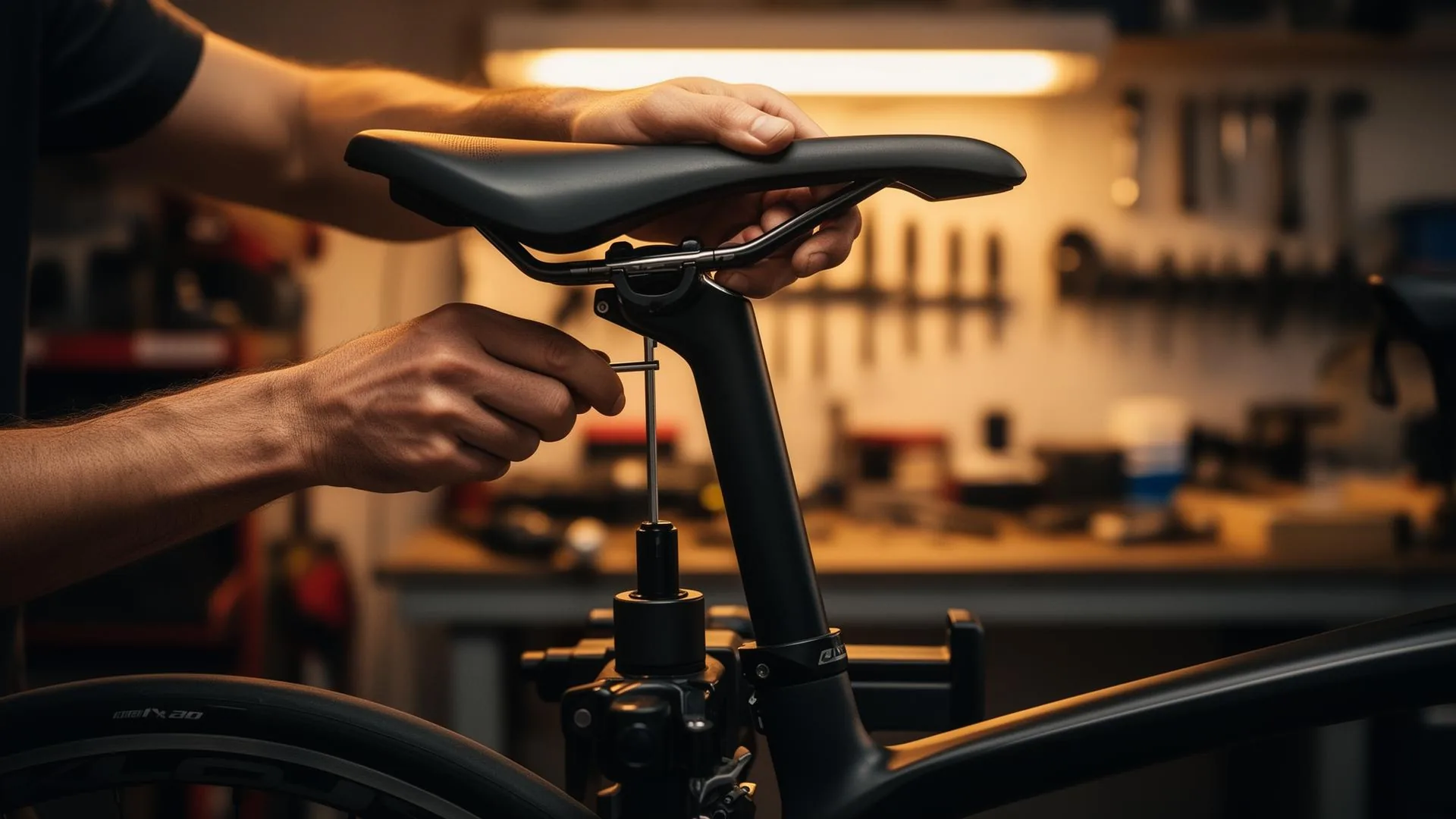
Step 3: Set the height. Loosen the seat clamp with an Allen key, slide the seatpost to the correct height and tighten securely. For a carbon seatpost or frame: use a torque wrench and follow the specified torque setting.
Step 4: Take a test ride. Ride at least 15 to 20 minutes on flat terrain. Pay attention to two things: is your pelvis rocking side to side? Your saddle is too high. Do your knees feel cramped at the top of the pedal stroke? Your saddle is too low.
Step 5: Give it time. Ride a few rides at the new height before making further adjustments. Then adjust another 5 mm if needed, until you reach the calculated value.
Step 6: Keep in mind that saddle height affects your handlebar drop. When you raise your saddle, the drop (the height difference between saddle and handlebars) increases. This can affect your comfort. In our article on setting up your road bike, we explain how these adjustments are connected.
Frequently asked questions
What is the correct saddle height for my height?
There is no fixed table that gives you a saddle height based on your body height. It doesn't work that way. Your inseam is a much better measure than your overall height, because two people of the same height can have very different leg proportions. Use the saddle height calculator at the top of this article as a starting point.
How do I calculate the saddle height for my road bike?
Measure your inseam barefoot (stand against a wall, book pressed firmly into your crotch, measure from the floor to the top of the book). The quickest formula is inseam × 0.883. This gives you the distance from the centre of the bottom bracket to the top of the saddle. Our calculator at the top of this article gives a more accurate result because it also accounts for your crank length, shoe size and riding goal.
Is the LeMond or Hamley method better?
Neither is better. For an average height and crank length, they produce virtually the same result. For shorter or taller cyclists, or with an unusual crank length, they can differ by up to 20 mm. The difference is in how you measure: with Hamley you measure from pedal axle to saddle (including crank length), with LeMond from bottom bracket to saddle (excluding crank length).
Can wrong saddle height cause knee pain?
Yes. A saddle that's too low increases knee flexion at the top of the pedal stroke, raising pressure on the kneecap, the most common cause of anterior knee pain. A saddle that's too high can cause pain at the back of the knee from overextension. In our article on knee pain while cycling, we explain each type of knee complaint and how to fix it.
Should I adjust my saddle height when I change cranks?
Yes. If you switch from 172.5 mm to 165 mm cranks and you measure your saddle height from bottom bracket to saddle, that measurement doesn't change. But the distance from pedal axle to saddle decreases by 7.5 mm, which changes your knee angle. To maintain the same knee angle, you need to raise your saddle by 7.5 mm.
What is the difference between saddle height and saddle position?
Saddle height is the distance from the bottom bracket to the top of the saddle. Saddle position encompasses more: also the horizontal position (setback) and the tilt of the saddle. All these adjustments are interconnected. You can have a perfect saddle height, but if your setback or saddle tilt is off, you can still develop problems. A complete bike fit looks at all these adjustments together.
Does optimal saddle height differ by bike type?
The biomechanical principles are the same, but the application differs. On a mountain bike you want more control and stability, which often means a slightly lower saddle. On a gravel bike it depends heavily on how you ride: if you mostly ride smooth paths, the setup leans closer to a road bike. If you ride more technical terrain, the setup shifts towards a mountain bike. The calculator in this article is optimized for road bikes. For other bike types, you can use our online bike fit, which takes your cycling discipline into account.
Related articles
Road bike saddle setup: saddle height and setback guide
Road bike saddle setup, step by step: correct saddle height, saddle tilt and setback for your body. Prevent pains and ride faster with the right setup.
Dynamic vs static bike fit: which method suits you?
Dynamic vs static bike fit — Both methods have serious pros and cons. An honest comparison based on scientific research and practical experience.
Ready to optimise your bike fit?
Get a personalised bike fitting report in just 15 minutes.
Start your bike fit