

Want a Good Bike Fit? Avoid These 6 Pitfalls
Which bike fit methodology and provider is right for you? 6 practical tips for a good bike fit.

There are several ways to get your bike set up optimally. You can experiment with free online tools or hire a professional for a good bike fit, which can cost a few hundred euros.
What Is the Best Bike Fit Method?
But how do you know which bike fit method is best for you? Is a free tool good enough? Or do you really need an expensive bike fit for proper advice? And which bike fitter gives the best advice? After all, if you have a bike fit done by multiple providers, the results can vary considerably.
Good and Reliable Advice
You want a good, reliable result. Otherwise, you risk ending up in the wrong position on your bike anyway. Any existing issues could then worsen. And perhaps that wrong advice will lead you to buy a bike that doesn't suit you. That's something you want to avoid.
Lack of Clarity Is Frustrating
This lack of clarity is frustrating. We understand. We're cyclists ourselves and have struggled with the same questions. That's why we founded Best Bike Advice.
Our Team of Specialists is Here to Help You
The Best Bike Advice bike fit team consists of several experienced bike fitters, a sports doctor, and a mathematician. We have studied numerous scientific papers on bike fitting and have tested many bike fit tools and physical bike fitters. The differences in quality between the various providers of bike fit solutions were shocking.
Which Methodology and Provider Should I Choose?
We'd like to help you with 6 practical tips so you can get a reliable bike fit. Which bike fit methodology and which provider is the best choice? There's no simple answer to that.
The optimal choice depends on several personal factors, such as:
- Your ambitions.
- Your budget.
- Any injuries.
- Physical limitations.
In this article, we'll briefly explain these tips. In our knowledge centre, we also have an in-depth article for each tip with more examples and explanations.
The tips:
- Don't choose a frame size based on your height or leg length
- A good bike fit focuses on you, not your bike
- A good bike fit includes a thorough intake process
- A bad bike fit is often the result of inaccurate measurements
- Choose the bike fit methodology that suits you
- Check independent reviews before getting a bike fit
1. Don't Choose a Frame Size Based on Your Height or Leg Length
Many bike brands and shops want to make buying a bike as easy as possible. That's why they present charts that suggest a frame size based on your height and/or leg length. This method is very unreliable. For 30% of cyclists, it provides the wrong frame size advice.
If you want to buy a new bike, you have two good options. Do you currently have a bike you feel good on? Then make sure you can replicate the same riding position on the new bike. Don't have a good reference point? Then at least perform a basic bike fit.
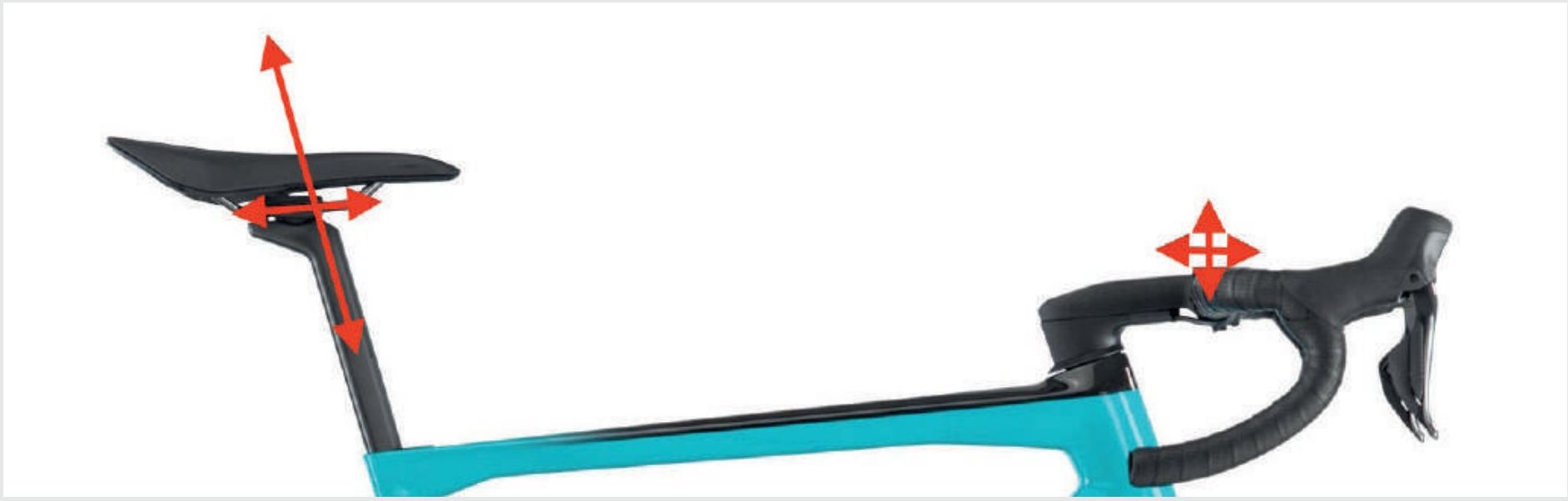
Why do we advise this? Two people of the same height can need very different sizes. Someone with relatively short legs needs a larger bike size than someone of the same height with relatively long legs. We explain this in detail in our article "What Road Bike Size Do I Need?". The key takeaway is that a saddle has a very wide adjustment range. Your handlebar position does not. That's why your torso—not your leg length—is the determining factor when choosing a frame size.
2. A Good Bike Fit Focuses on You, Not Your Bike
Initially, you should get a bike fit independently of a specific bike model. First, you want to find out what your optimal riding position is. Once you know what that is for you, you can see if it can be achieved on your current bike, or on the bike you're planning to buy. If it's not a good match, you can always consider a compromise in your riding position.
What if you start the bike fit based on the bike you have or the one you want to buy? There's a drawback to that. You risk consciously or unconsciously working towards that bike's parameters, which means you'll be adapting your riding position to the bike. And that's not the goal. You want to buy a bike that is optimally suited to you.
3. A Good Bike Fit Includes a Thorough Intake Process
A bike fit is always a personal compromise. For optimal aerodynamics, you want to be as low as possible on the bike. But for comfort, this position isn't ideal. Optimising for short bursts of peak power places different demands on your position compared to optimising efficiency for long rides. Furthermore, your bike fit also affects the bike's agility and stability. The latter plays a particularly important role for mountain bikes and cyclocross bikes.
A good bike fit is therefore based on a personal compromise between all these factors. When you go for a bike fit, make sure your flexibility, cycling goals, skill level, and priorities are thoroughly discussed beforehand and taken into account in the advice. A good bike fit tool or bike fitter will map this out in detail.
4. A Bad Bike Fit Is Often the Result of Inaccurate Measurements
Most paid bike fits are based on the same underlying bike fit guidelines. Yet, the results from different bike fits for the same person can vary considerably. We've tested this ourselves. In Belgium, Ghent University has also conducted research on this.
A bad bike fit can have several causes, but it's often the result of inaccurate measurement. And measurement errors happen everywhere, even with expensive 3D bike fit systems and AI video analysis.
Digital Measurements in Photos or Videos Are Less Reliable
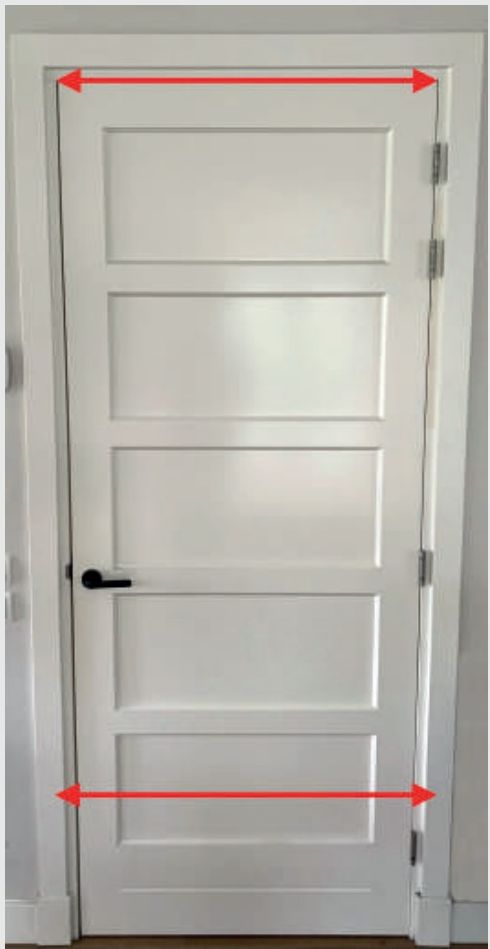
A digital measurement in a photo or video is less accurate than a real-world measurement. A camera lens can distort reality, as the perspective of the 3D world is flattened into 2D. You can see this in the photo of the door. The two red lines are digitally the same length, but they do not represent the same distance in the real world.
For a Dynamic Bike Fit, You Need to Pedal at an Appropriate Power Output
When you pedal with more power, you use different muscle groups than when you pedal with low power. You also need a different riding position. Just look at the average posture of someone on an e-bike; it's usually extremely upright. Are you getting a dynamic bike fit? Pay close attention to whether the power output during the test corresponds roughly to the power you normally produce.
A Measurement by an Experienced Bike Fitter Is More Reliable Than a Self-Measurement
This is probably self-explanatory. However, there are also experienced bike fitters who make systematic errors without realising it. For example, as a test, we had an expensive 3D bike fit done where the resistance on the sizing bike was set far too low. The result: an incorrect bike fit.
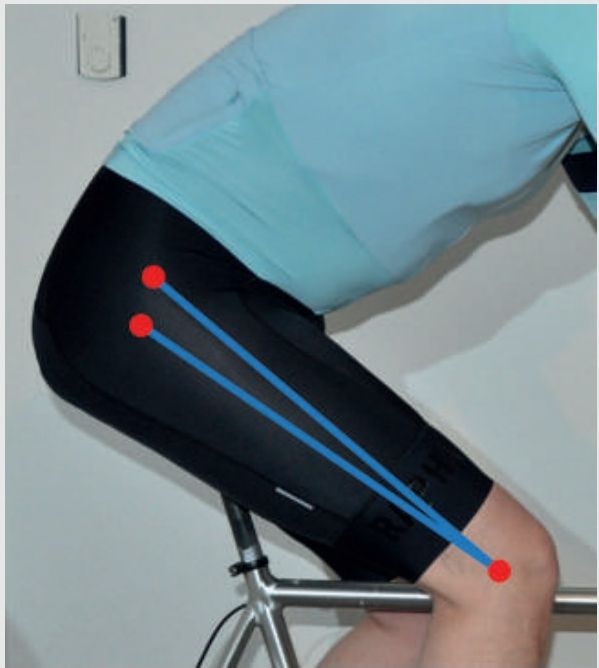
Measuring Angles Accurately Is Difficult
When you measure an angle, you need to determine the body's "pivot points." This is quite tricky, especially at the hip, for example. In a video analysis by an AI bike fit tool, we saw this pivot point jump around significantly. In the adjacent image, you can see the pivot point determined by the AI. We've placed the pivot point from two different video frames into one image. You can immediately see how big the impact is on the measured angle.
5. Choose the Bike Fit Methodology That Suits You
A bike fit can be done in several ways. You have the bike shop employee who gives a quick visual check to see if everything looks more or less okay. But an extensive wind tunnel simulation test is also an option. How much do you want to spend on a bike fit, and how reliable do you want it to be? The costs are usually clear. But comparing reliability and accuracy is often much harder.
Free Bike Fit Tools
Free online bike fits are almost always marketing tools. They aren't standalone, fully developed products. The methodologies used are usually based on simple rules of thumb. We've tested several free bike fit tools. In some cases, these tools give reasonable results, but in other situations, they were completely off. If you'd rather not spend money on a bike fit, you can start with these tools.
Paid Bike Fit Tools
We have also tested several paid tools. they all use bike fit guidelines comparable to those of professional bike fitters. Many tools measure body angles in an image of you on your bike. Some tools ask you to measure your body dimensions and calculate the same angles from them. The paid tools are a lot better than the free ones. For most cyclists, a paid tool is a good compromise between cost and reliability.
Physical Bike Fitters
The most reliable bike fit is a dynamic bike fit with a top bike fitting expert. A good bike fitter conducts a thorough personal intake. A good fitter also has a lot of experience, allowing them to perform measurements more accurately than you can. Do you have an injury or specific physical issues, such as a leg length discrepancy or a spinal deviation? Then we definitely recommend going to a physical bike fitter.
Dynamic vs. Static Bike Fit
During a dynamic bike fit, you ride on a kind of stationary trainer. The bike fitter records a video while you pedal and then takes measurements from the paused video. The big advantage of this method is that it looks at your actual riding posture. Unfortunately, there's also a disadvantage: the chance of measurement errors is greater.
With a static bike fit, the measurement is easier and more accurate to perform. The disadvantage is that it doesn't account for deviations in your riding style. Do you have a "normal" riding style? Then a static bike fit works well. But do you cycle with an unusual ankle angle or a curve in your back? Then you're better off with a dynamic bike fit.
→ Read more: dynamic vs. static bike fit
6. Check Independent Reviews Before Getting a Bike Fit
The quality and reliability vary greatly among different tools and also among physical bike fitters. Therefore, choose a provider with good personal references or good public customer reviews. These are independent reviews on sites like Google Reviews and Trustpilot—not the reviews on the bike fit provider's own website.
Ready for a Good Bike Fit?
A lot can go wrong with a bike fit. This means you risk spending a lot of money and still ending up in the wrong position on your bike. You might buy the wrong components or even the wrong bike, causing any existing issues to worsen rather than improve.
So, make sure you make an informed choice. And be critical yourself when you get a bike fit. Are you using a bike fit method that requires you to take your own measurements? Be sure to do so carefully. Read the instructions well and ask for a second person's help to measure more accurately.
Do you have a serious injury or an unusual riding style? Then go to a good bike fitter who can perform a comprehensive physical examination and a dynamic bike fit. Preferably choose a fitter with good knowledge of the human body, such as a sports doctor, physiotherapist, or human movement scientist.
Don't need a comprehensive physical examination? Then a good bike fit tool is a reliable and much cheaper solution. Best Bike Advice is a very comprehensive and reliable bike fit tool. Our bike fit is used by more than 20,000 satisfied customers every year. We receive an average Trustpilot rating of 4.3 from these customers. We are confident in the quality of our bike fit, which is why we offer a money-back guarantee.
Want to know exactly which measurements suit your body? Take our online bike fit and get your personal report right away.
Related articles
Dynamic vs static bike fit: which method suits you?
Dynamic vs static bike fit — Both methods have serious pros and cons. An honest comparison based on scientific research and practical experience.

What road bike frame size do I need?
How to choose a Road bike frame size: don't pick based on height or leg length. Use stack and reach to determine the correct bike frame size for your position.
Ready to optimise your bike fit?
Get a personalised bike fitting report in just 15 minutes.
Start your bike fit