
Understanding and applying your bike fit
How to read your bike fit advice and translate it into a correctly set-up bike.

You have just received your personal bike fit advice. This article helps you understand the thinking behind it and shows you how to apply it correctly to your bike. A good riding position makes a real difference to how you ride - and getting there starts with understanding what the advice means.
In this article:
- Why your riding position matters
- Why body height doesn't determine your bike size
- The Best Bike Advice measurement definitions
- Setting up your bike step by step
- Adjusting the cockpit: stem, spacers and rise
- Getting the most out of your advice
Why your riding position matters
The way your bike is set up has a large influence on five things that matter to every cyclist:
- Peak power - realising your maximum power and speed.
- Efficiency - using as little energy as possible, which matters most on long rides.
- Comfort - limiting aches in your neck, back, shoulders and elsewhere.
- Injury prevention - avoiding overuse injuries.
- Bike handling - keeping maximum control and agility.
There is no single setup where all five are at their best at the same time. The right setup is always a compromise - and the best compromise depends on your cycling goal. If you want to go full gas for an hour, peak power outweighs efficiency. If you ride long distances, comfort and efficiency weigh more heavily.
Your personal characteristics matter too. Younger riders, for example, are often less sensitive to comfort and injury than riders who are older. Based on your cycling goals and your body, we have calculated the setup that strikes the right balance for you.
Why body height doesn't determine your bike size
It is tempting to pick a frame size based on body height. It is easy, but it is not accurate. Body height is only a rough indication.
Frame size is traditionally based on the seat tube, and therefore on saddle height. But saddle height has a very large adjustment range - with a 40 cm seat post you have around 25 cm of adjustment. There are usually several frame sizes on which your saddle can be set to the right height. So saddle height rarely determines which frame fits you.
What really matters are the stack and reach of the frame, because these can only be adjusted within narrow limits - and often only by replacing parts such as the stem.
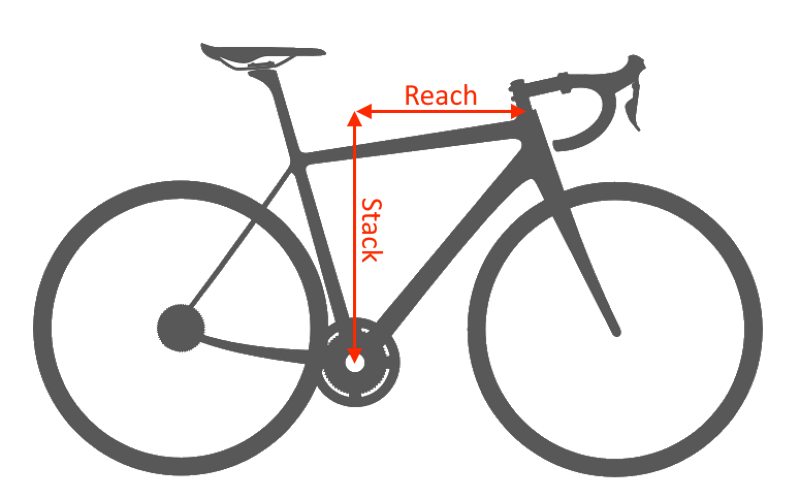
Stack and reach depend directly on your torso length and arm length, and on the back angle you want to ride with. If you want a very aerodynamic position, your handlebar needs to be low and far away (small stack, large reach). If you want plenty of comfort - a more upright back angle - you need a larger stack and a smaller reach. This is why two people of exactly the same height can need a completely different frame size.
The Best Bike Advice measurement definitions
Your advice gives you the bike setup you need for an optimal riding position. To apply it correctly, it is essential that you use the same measurement definitions that Best Bike Advice used to calculate it. Using a different definition when adjusting your bike leads to a wrong result.
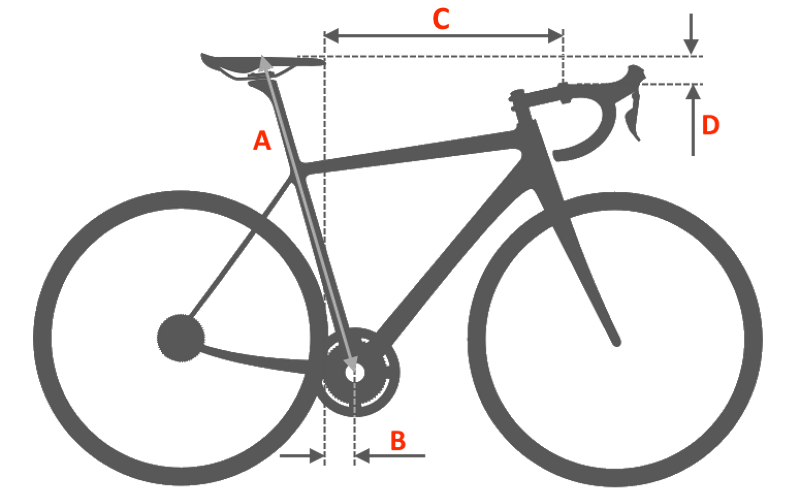
- A. Saddle height - the distance from the centre of the bottom bracket to the top of the saddle, measured along the line of the seat tube.
- B. Saddle setback - the horizontal distance between the bottom bracket and the front of your saddle.
- C. Saddle to bar distance - the horizontal distance between the front of your saddle and the middle of the handlebar.
- D. Drop - the height difference between the top of your saddle and the top of the handlebar on a road bike, or the top of the grips on a mountain bike. Drop is negative when the handlebar is lower than the saddle.
Measuring these on your own bike
- Put your bike on a level surface before measuring.
- Saddle height and saddle to bar distance can be measured directly with a tape measure.
- Setback: put the rear wheel against a wall. Measure A, the distance from the wall to the centre of the bottom bracket, and B, the distance from the wall to the front of your saddle. Subtract B from A (A - B = setback).
- Drop: measure A, the height of the top of the handlebar from the ground on a road bike, or the top of the grips on a mountain bike (with the handlebar straight), and B, the height of the top of the saddle from the ground. Subtract B from A (A - B = drop). A negative result means your handlebar should be lower than your saddle.
Setting up your bike step by step
When you adjust your bike, work from your feet towards your hands. This order matters, because a change at the start of the chain affects the changes that follow. If you install a crank that is 5 mm longer, for example, your saddle needs to go 5 mm lower - and to keep the same drop, your handlebar would need to go 5 mm lower as well.
Never make large changes in one go. Adjust in small steps and let your body get used to each step over a few rides. For saddle height, a good guideline is to change it by no more than 5 mm at a time. Large jumps can lead to complaints and injuries.
The individual contact points - saddle width, saddle tilt, handlebar width, cleat position and crank length - each have their own article in the knowledge centre. And to translate your advice to a specific bike, the Bike Setup Tool calculates exactly which parts you need.
Adjusting the cockpit: stem, spacers and rise
Your saddle to bar distance and drop are realised through the cockpit - a combination of the stem, the spacers, and (on mountain bikes) the handlebar rise.
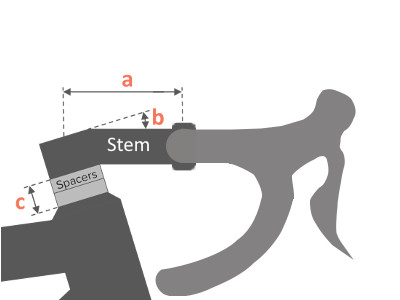
- Stem - available in various lengths and angles. A longer stem is more stable and suits road bikes and cross-country mountain bikes. A shorter stem is better for technical steering. Note that a stem can be mounted with the angle pointing down or up.
- Spacers - rings placed around the steerer tube above the frame, used to set the stem higher. We assume a maximum of 4 cm of spacers. Some bike brands pre-cut the steerer tube, leaving less room - in that case a different stem or handlebar can help.
- Handlebar rise - a mountain bike handlebar can be flat, or it can curve upwards so the grips sit higher. This height difference is called the rise. We assume a maximum rise of 50 mm, although bars with more rise are available.
Together, the stem, spacers and rise determine your saddle to bar distance and drop. Our Bike Setup Tool calculates the right combination for your bike.
Getting the most out of your advice
Your advice is only as accurate as the body measurements it is based on. Measurement mistakes are easy to make, so take your time - and measuring accurately requires help from a second person. This is the single biggest thing you can do to get an excellent result.
Our method is objective and thorough: it is built on expert input, research, and a comparison of a very large number of bikes and parts. What a model calculation cannot do is account for every individual exception, such as a difference in leg length or an unusual foot angle.\nYour advice is optimised for cycling shoes with clipless pedals. If you ride with normal shoes on platform pedals, you may need a slightly higher saddle position, depending on the thickness of the sole.
This advice is a guide to help you choose a bike - it is not a guarantee that a particular bike will fit you. Always test ride a bike before buying it to confirm it suits you.
Have a question, or do you see room for improvement? Get in touch with us - we are always happy to help.
Curious what online bike fitting can do for your comfort and power?
Related articles
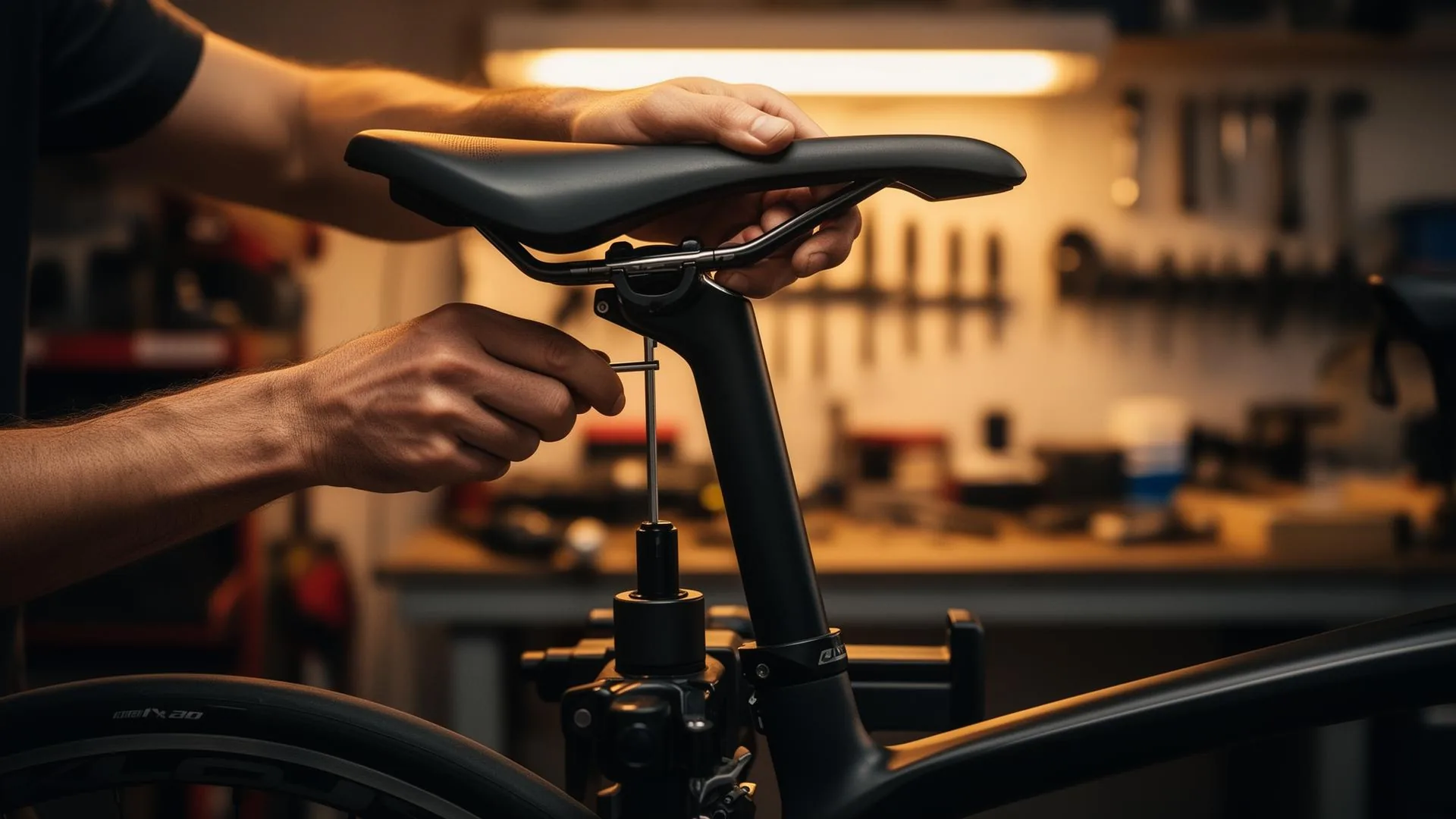
Road bike saddle setup: saddle height and setback guide
Road bike saddle setup, step by step: correct saddle height, saddle tilt and setback for your body. Prevent pains and ride faster with the right setup.
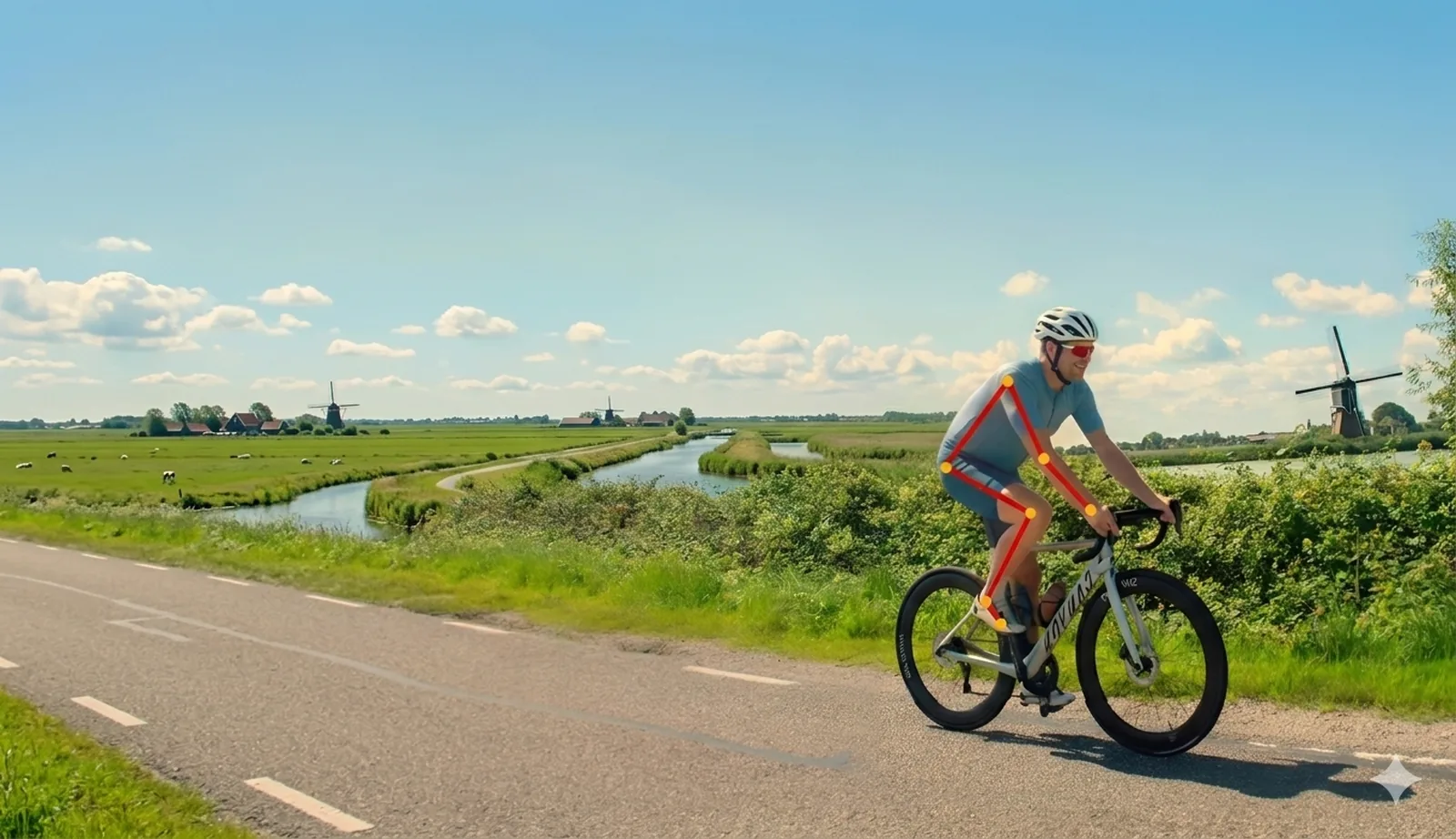
What is the ideal road bike position?
Road bike position — Your bike position and fit are more important than you think, and most riders don't know enough about it.

What road bike frame size do I need?
How to choose a Road bike frame size: don't pick based on height or leg length. Use stack and reach to determine the correct bike frame size for your position.
Ready to optimise your bike fit?
Get a personalised bike fitting report in just 15 minutes.
Start your bike fit